Ivory Coast
14 references

The objective of this facility is to improve the overall quality of the NDICI Rapid Response and Peace, Stability and Conflict Prevention thematic areas by providing high quality research services.
We will provide the FPI with flexible and ad hoc research services and prepare literature reviews and rapid assistance reports in the thematic areas specified below.
- Partners:
- Particip (Lead), SICI Dominus
- Keywords:
- Environment, Humanitarian aid

Formulation Regional Transnational Organised Crime Programme WCA
- 2023 – 2024
- under € 500,000
- Africa (Western)
The contractor undertook the formulation of an Action Document (AD) to implement a regional program addressing illicit trafficking and transnational organized crime in selected West African and neighboring Central African countries. This included providing all necessary inputs and conducting comprehensive analysis, documentation review, fact-finding work, and consultations to propose possible options/scenarios for program focus and intervention logic. This work identified key strategic questions/issues to support informed discussions with relevant EU Delegations and other key stakeholders
- Partners:
- Particip (Lead), EuroPlus
- Keywords:
- Governance, Human rights

Thematic evaluation of FPI.2 managed responses to Counter Terrorism and Preventing/Countering Violent Extremism (CT-P/CVE) in beneficiary countries (2017-2022)
- 2022 – 2023
- under € 500,000
- Albania, Burkina Faso, Indonesia, Ivory Coast, Jordan, Kazakhstan, Kosovo, Kyrgyzstan, Lebanon, Malaysia, Maldives, Morocco, Mozambique, Niger, North Macedonia, Pakistan, Philippines, Senegal, Sri Lanka, Tajikistan, Thailand, Tunisia, Turkmenistan, Uzbekistan
The main objectives of this evaluation are to provide the relevant services of the European Union, the interested stakeholders with:
- An overall independent assessment of the performance of selected CT-P/CVE measures funded by FPI.2 during the years 2017-2022, paying particular attention to its different levels of results measured against its expected objectives; and the reasons underpinning such results
- As a particular approach to regional actions, a specific case study shall be carried out to assess the regional framework for support to CT-P/CVE measures in the Asian context, managed by the Regional Team in Bangkok. It is expected that the present evaluation assesses the relevance, added value and success of developing a model for CT and P/CVE actions, respectively, which have been replicated in different countries/contexts in Asia/Pacific (in Pakistan, Sri Lanka and Maldives for CT; and in Southeast Asia, Sri Lanka and Maldives for P/CVE). If deemed relevant, links can also be made to regional approaches in other RTs;
- Key lessons learned, conclusions and related recommendations in order to improve current and future interventions.
In particular, this evaluation will serve the contracting authority and other interested services to better understand the performance of the Intervention, its enabling factors and those hampering a proper delivery of results to inform the planning and implementation of current and future support to tackle CTP/CVE.
The main use of the results of the evaluation is expected to be
- To draw general lessons that can be used for the future approach to interventions in the sector
- To draw specific lessons that can be replicated in other similar interventions
- To draw specific lessons from the regional approaches, in particular the one applied by the Regional Team in Bangkok in terms of stocktaking, dynamics and replicability.
The main users of this evaluation will be the contracting authority, FPI.2, including its Regional Teams in Bangkok, Nairobi, Dakar, Eastern Europe and Central Asia (managed from Brussels). The Regional Team in Brasilia is less involved since they currently do not manage any CT-P/CVE projects.
- Keywords:
- Monitoring & Evaluation

Communication and visibility of the European Union in Ivory Coast
- 2019 – 2022
- € 1 – 2 million
- Ivory Coast
The global objective of the project was to raise awareness about the comprehension of the EU and its support and actions in Ivory Coast, particularly targeting the ivorian audience.
The specific objectives were the following:
- develop a global communication and visibility strategy for the EU-Ivory Coast partnership, including the annual strategy of the EUD in Ivory Coast and its project.
- effectively communicate about the EU's values and the benefits from the EU-Ivory Coast partnership to the ivorian audience.
- communicate and ensure visibility of the partnership that is i) integrating a real political dialogue about issues of common interest, beyond the cooperation aspects; ii) going beyond the classical cooperation (project type) to support the government's reform (budget support); iii) based on universally shared values and the living together
- raise awareness of the ivorian audience for the EU's programmes
- enhance the impact of visibility activities of EU financed project in the short, middle and long term on the living situation of population and the country's development.
- Keywords:
- Communication & media
Final evaluation of the Gouvernance Support Programme
- 2019 – 2020
- under € 500,000
- Ivory Coast
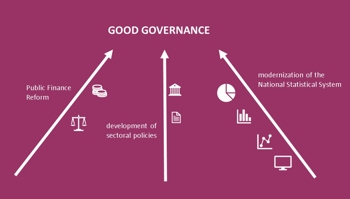
The overall objective of this programme was to contribute to the strengthening of the peace and recovery process in Côte d'Ivoire with a view to improving and promoting good governance. Situated at the crossroads of the main cross-cutting issues contained in the European Consensus on Development, the GAP supports the strengthening of governance in Côte d'Ivoire through 3 main components:
Axis 1. Support for the implementation of the Public Finance Reform for results-based budget management in line with the WAEMU Budget Reform.
- Component R1.1 - Institutional support to the Ministry of Economy and Finance (MEF) Component
- R.1.2 - Institutional support to pilot sectors of WAEMU reform: Component
- R1.3 - Support for institutional capacity building :
Axis 2. Support for the development of sectoral policies :
Contribution to the development of sectoral policies in certain key sectors that have a direct impact on poverty and the root causes of the crisis (health, education, water, sanitation, national identity/civil status, agriculture, rural land tenure, etc.), in line with the orientations taken in the framework of the WAEMU Reform, as well as in more cross-cutting sectors such as the environment (membership of FLEGT, Forest Law Enforcement, Governance and Trade), or decentralization :
Axis 3. Support for the modernization of the National Statistical System :
Institutional support to the National Institute of Statistics (NIS) in the implementation of the National Strategy for the Development of Statistics:
For the implementation of the GAP, in addition to equipment support granted to the structures involved in the PPPBSE chain and specific support to the Chamber of Accounts in the form of a PD, two technical assistance packages were mobilised, namely
- The Project to Support the Implementation of Results-Based Budget Management (PAGAR) for the "Reform of Public Financial Management" component; and ;
- the Project to Support the Planning and Statistics System (PAPS) for the components "Development of Sectoral Policies" and "Modernization of the National Statistical System (NSS)".
The assessment shows that the problems have been well targeted but less well addressed. Weaknesses were noted at the level of ownership of the programme by the ministries, the institutional anchoring of technical assistance, the synchronization of the two programmes, the monitoring of programme outputs, etc. The evaluation shows that the programme has been well targeted but less well addressed. All of these weaknesses have been identified and documented in the various evaluations and ROMs conducted on the project.
A mid-term evaluation with the main objective of providing stakeholders with an objective and reliable assessment of the implementation of the GAP with conclusions, recommendations, and lessons learned, likely to lead to proposals for updating, improving and revising the programme with a view to better implementation, based on the needs of the country and the performance achieved by the country in the governance sector was carried out from 23 November 2016 to 26 January 2017 by the evaluators of the DECG (Department of Evaluation and Management Control) of the National Authorizing Officer's Unit.
- Partners:
- Particip (Lead), ADE
- Keywords:
- Governance, Monitoring & Evaluation

European Union Election Expert Mission in Ivory Coast
- 2020 – 2020
- under € 500,000
- Ivory Coast
The purpose of the Election Expert Mission (EEM) was to collect and analyse factual information, assess and report on the electoral process against international commitments, standards and good practice for democratic elections in line with the criteria contained in the Commission Communication on Electoral Assistance and Observation [COM(2000)191]. The experts also formulated recommendations to improve future electoral processes and assess, when relevant, the state of implementation of recommendations made by previous electoral missions.
- Keywords:
- Elections
External Evaluation of EU’s Support to Conflict Prevention and Peace Building (2013-2017)
- 2018 – 2020
- € 500,000 – 1 million
- Global
This evaluation took place in a context of a recent surge in violent conflicts and a renewed momentum on Conflict Prevention and Peacebuilding (CPPB) both at the EU and global level. Its purpose was to:
- provide the relevant EU Institutions and the wider public with an overall independent assessment of the EU support to CPPB focusing on the period 2013-2017; and
- identify key lessons, instil good practices, and produce recommendations to feed into ongoing and future approaches to EU’s engagement in the field of CPPB.
In particular, the evaluation will feed into the EU implementation of the Integrated Approach to Conflict and Crises and nurture future EU support to CPPB strategies and interventions.
The scope of the evaluation included:
- all relevant actions (including spending and non-spending activities) and all countries/regions which fall under the responsibility of DG DEVCO and DG NEAR (neighbourhood region only); and
- the work/engagement of EEAS related to them.
In terms of temporal scope, the evaluation focused on the period 2013-2018, but also took the period 2011-2012 into consideration in order to assess the evolution of EU support to CPPB.
Through the course of the evaluation, the evaluation team conducted 12 case studies (focusing on countries, regions and instruments) which were subject to an in-depth analysis, including eight field visits. Two surveys – one covering EU services in Brussels, the other covering EU Delegations/Offices worldwide – were also part of the data collection and analysis process. Findings from all evaluation activities were synthesized into a final report.
The final report is available online: https://ec.europa.eu/international-partnerships/external-evaluation-eus-support-conflict-prevention-and-peacebuilding-2013-2018_en
- Partners:
- Particip (Lead), ECDPM
- Keywords:
- Governance, Monitoring & Evaluation

Mid-Term evaluation of the Fondation Pour Les Parcs Et Reserves De La Cote D’ivoire - FPRCI
- 2019 – 2019
- under € 500,000
- Ivory Coast
The Foundation for Parks and Reserves of Cote d'Ivoire (FPRCI) is an association under private law for the management and financing of national parks and nature reserves and. In total, funding is provided to 7 national parks, focusing mainly on 4 parcs (Taï, Comoé, Azagny, and Mont Sangbé), whose operating costs are covered. Three other parks and reserves have been added to the list since January 2017: Mount Nimba Strict Reserve, Lamto Science Reserve and Ehotilé Islands National Park.
The total cumulative amount granted to the OIPR for the last 5 years is €8.24 million.
The mission consisted of carrying out a mid-term evaluation of the FPRCI in order to evaluate:
- the organisational structure in relation to the statutory tasks
- technical and financial management systems
- technical and financial internal and external control
- coordination with key partners
- reporting, achievement and adequacy of objectives, outcomes and outputs
The review of operating procedures and procedures for the implementation of activities made it possible to establish a diagnosis of the functioning and formulate recommendations aimed at increasing the efficiency of actions and reducing risks.
- Keywords:
- Environment, Monitoring & Evaluation, Public finance/budgeting

Mapping social media and its interactions with civil society in Ivory Coast
- 2019 – 2019
- under € 500,000
- Ivory Coast
The overall objective of the mission was twofold:
- Map the social media in Côte d'Ivoire and its interaction with civil society organisations;
- To develop operational recommendations for a more effective orientation of EU and international government/PTF and NGO funded support to the media in general.
Specific objectives:
- OS1 : To identify the actors present on the scene by carrying out an inventory of the current social media landscape in Cote d'Ivoire. media in Cote d'Ivoire;
- OS2 : Analyse the relationship/interaction of social media with civil society organisations and traditional media Civil Society Organisations and traditional media;
- OS3: Identify the strengths, weaknesses and opportunities of social media in strengthening democratic governance in Cote d'Ivoire of democratic governance in Cote d'Ivoire. This also meant analysing the social media both as an instrument that can contribute to political debate and peaceful dialogue or, on the contrary, as an instrument of destabilisation;
- OS4: Develop operational recommendations on how the EU could engage more with the media in general in the framework of its support to Civil Society Organisations and Human Rights, in particular in the implementation of the LIANE II project and the EIDHR, CSO and IcSP instruments.
- OS5: Develop operational recommendations to public authorities, TFPs and international NGOs on how to support the on how to support the media sector (all).
- Partners:
- Particip (Lead), EuroPlus
- Keywords:
- Civil society

The objective of this project was to provide the support of an electoral / legal expert to the European Service for External Action, and in particular to the Delegation of the European Union (DUE) in Abidjan, to take stock of the situation. the implementation of the recommendations of the electoral missions deployed by the EU and the electoral framework in Côte d'Ivoire in the context of the preparation of the next elections of Côte d'Ivoire and to make proposals, by setting priorities short, medium and long term, which will guide the action of the European Union.
The electoral / legal expert studied, on the basis of the recommendations made by the EOM 2010 and the MEEs 2011 and 2015, the institutional and legal evolutions relating to the electoral framework and respect for public liberties, and drew up a final report of study covering the entire exercise.
- Keywords:
- Elections

External evaluation of the European Union's cooperation with the Republic of Ivory Coast 2007-2015
- 2015 – 2018
- under € 500,000
- Ivory Coast
The evaluation assessed the EU’s cooperation strategy in Côte d’Ivoire as well as its implementation between 2007 and 2015. Both levels – strategy and implementation – were evaluated. The main objectives of the evaluation were:
- to provide a global and independent assessment of the past and current EU cooperation and to put it into perspective with the general objectives and political priorities of the EU with regards to the country, not only for EU services but also for member states and for a broader public in general;
- to draw the main conclusions and to formulate recommendations in view of (i) improving current decisions and (ii) providing better information for future decision-making with regards to the cooperation strategy;
- produce a document that will serve as base for the upcoming joint programming in 2016 between EU, France, Germany and Spain, and which will answer to the challenges of such an effort.
The scope of the evaluation covered:
- All agreements, the cooperation framework and other official commitments of both EU and Ivory Coast, including the objectives and priorities of EEAS with regard to EU-Côte d’Ivoire relations.
- The following financial instruments: envelopes of the European Development Fund (EDF), of the European Instrument for Democracy and Human Rights (EIDHR), of the Instrument for Stability (IfS) and of thematic programmes financed through Development Cooperation Instrument (DCI).
- The coherence between interventions managed by DG DEVCO-EuropeAid and those managed by DG ECHO, the European Investment Bank EIB or other EU interventions and policies in the field of development cooperation which affect Côte d’Ivoire. A particular attention will be laid on the interim economic partnership agreements (EPA) with Côte d’Ivoire for the fisheries sector.
The report is available at:
https://ec.europa.eu/international-partnerships/external-strategic-evaluation-eus-cooperation-republic-cote-divoire-2007-2015_en
- Partners:
- Particip (Lead)
- Keywords:
- Agriculture, Civil society, Education, Energy, Food and nutrition, Governance, Health, Human rights, Humanitarian aid, Infrastructure, Justice/Rule of Law, Monitoring & Evaluation, PCM / Logframe, Public finance/budgeting, Trade

Identification and Formulation of Support to West Africa Peace, Security and Stability: Complementary action combatting other main threats
- 2016 – 2017
- under € 500,000
- Africa (Western)
This assignment provided a coherent proposal to ECOWAS and EU for the strengthening of coordination and cooperation in security in West Africa and the implementation of programmes dealing with specific threats.
It gave sufficient background information and justifications to enable the ECOWAS and EU to make an informed decision on specific objectives and of the projects' implementation modalities.
The specific objective of this assignment was to prepare all the necessary elements of 4 different Action Documents to implement 4 potential projects covering respectively areas A, B, C and D.(Area A: Border Management, Area B: Enhancing Cybersecurity in ECOWAS region, Area C: Support to GIABA, Area D: Fighting against illicit trafficking).
For each area A,B,C and D, it was required to proceed to:
- an identification of issues, strategical orientations and priority intervention areas
- a formulation of the project under 11th EDF (Phase II).
- Partners:
- Particip (Lead), EuroPlus
- Keywords:
- PCM / Logframe

Mid-Term Evaluation of the Banana Accompanying Measures - BAM Program in the Republic of Côte d'Ivoire
- 2016 – 2017
- under € 500,000
- Ivory Coast
The overall objective of the EU program to support the banana sector, of which this project was a part, is to contribute to the fight against poverty by supporting the competitiveness of the dessert banana sector in Côte d'Ivoire.
In this context the overall objective of the mid-term evaluation of the BAM program was to identify the main lessons learnt from the implementation at the current stage, to make recommendations of improvement and to make suggestions to assist future decisions on the program of the Banana Accompanying Measures in Côte d'Ivoire.
After the D+3 and the contractual limit of the funds of the Financing Agreement 22-548, the evaluation was to take stock of:
i) the commitment rates ii) the institutional set-up iii) the choice of modalities of implementation in order to draw immediate lessons learnt and possibly recommendations for future conventions.
In this context, the specific objective of this contract was to evaluate the modalities of implementation and to compare the results achieved with the objectives of each contract also at the level of the Financing Agreement for the various activities implemented in the framework of the financing agreement BAN / 22548, and to make suggestions for an optimal implementation of the remainder of the program.
- Partners:
- NIRAS GROUP (Lead)
- Keywords:
- Agriculture

Mid-Term Evaluation 'Sustaining and strengthening African Union’s Liaison Offices in post-conflict countries'
- 2016 – 2017
- under € 500,000
- Central African Republic, Ethiopia, Ivory Coast, Mali, South Sudan
The main objectives of the evaluation were to provide the relevant external co-operation services of the contributing partners the African Union and, when appropriate, the wider public with:
- an overall independent assessment of the past performance (from 1 January 2013 until 31 December 2015) of the intervention (Sustaining and strengthening African Union’s Liaison Offices in post-conflict countries), paying particular attention to the results of the project against its objectives;
- key lessons learnt and recommendations in order to improve current and future action.
The evaluation was intended to inform the remaining period of implementation of the project, as well as the additional support to the AULO from 1 January 2018.
Evaluations should serve decision-making, learning and management purposes. This evaluation did provide indications to both the AUC and partners on key aspects of the programme management, and fed in the discussion on perspective mandate renewals.
- Keywords:
- Governance, Humanitarian aid